HK$11.75 Million in Tax Refunded Two Years After the Objection Deadline
Hong Kong Tax Practice: Case Analysis
ONC Lawyers | Nov 2026
How We Secured a Refund After an Earlier Accounting Team Was Unsuccessful
An Offshore Profits Claim and Correction of Assessments under Section 70A
Key takeaway Missing the one-month objection deadline, even by two years, does not necessarily prevent a taxpayer from obtaining a correction and a refund of tax already paid. Our client had not made an offshore profits claim, and an earlier accounting team had been unable to resolve the matter. We found that the client had relied on incorrect tax advice that the original auditor had not adequately reviewed or verified, resulting in material errors in the tax filing. The client's transaction records also supported an offshore profits claim. We applied under section 70A of the Inland Revenue Ordinance (IRO), and the IRD accepted the correction, revised the assessments and refunded the overpaid tax.
Why Was This Case Difficult?
Four factors made this case particularly challenging:
- Tax had already been paid in full The client did not object after receiving the notice of assessment, but paid the entire amount on time. The assessment appeared final.
- The objection deadline had passed two years earlier By the time the client approached us, the one-month period for lodging an objection had expired two years earlier. Any late objection would have required separate statutory grounds.
- The errors were in the client's own return The IRD had assessed the tax using information submitted by the client. We therefore had to establish the errors in that filing and persuade the IRD to accept a correction.
- Another accounting team had been unsuccessful Before approaching us, the client had engaged another accounting team to follow up, without success.
We addressed these difficulties by establishing both the errors or omissions in the original filing and the offshore source of the profits. The IRD accepted our application under section 70A and refunded the overpaid tax.
The Case and the Original Filing
The client is a Hong Kong company engaged in cross-border trading of components. The director and her husband have lived in Mainland China for many years. Her husband is familiar with component suppliers and technical matters, while the director oversees the main business operations. They rarely visit Hong Kong and are unfamiliar with its tax system, so they relied on professionals for auditing and tax filing. The original auditor made no offshore claim for the relevant profits in the return, and the IRD assessed profits tax accordingly. The client did not object to the notice of assessment, instead paying the full amount on time. Another accounting team later took up the matter but was unsuccessful. By the time the client came to us for a review, the objection deadline had passed by two years. The correction applications covered three years of assessment: 2018/19 to 2020/21.
The client had not simply changed its mind about the tax treatment. Errors in the information prepared by the original auditor had led the client to believe that the profits had to be reported as Hong Kong-sourced. We first needed to identify the specific errors or omissions that had caused the excess tax and determine whether they qualified for correction under section 70A.
We identified the errors or omissions in the original auditor's report, tax computation and Profits Tax Return, explained how they were connected, and reconciled each proposed adjustment to profits with the tax already paid. This enabled us to show the IRD that the application addressed specific, verifiable errors in the original filing.
We then reconstructed the actual transactions that generated the profits: who developed the customers, negotiated and performed the transactions; where the key work was carried out; and how revenue and costs corresponded. We organised verifiable business records by transaction, linking the principal profit-generating activities to their locations to support the client's eligibility for an offshore claim.
With both aspects substantiated, we submitted a written application under section 70A of the IRO. We identified the errors or omissions, quantified their tax effect and explained why the relevant profits arose outside Hong Kong. The IRD accepted the application, revised the assessments and refunded the overpaid tax.
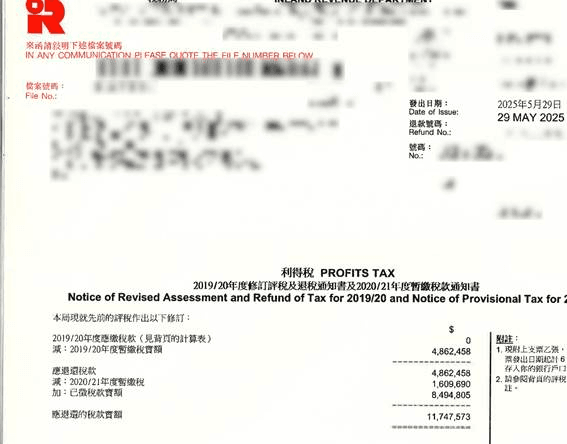
Figure 1 The IRD's revised assessment and tax refund notice for 2019/20: tax payable revised to HK$0 and a refund of HK$11,747,573 due (client and IRD details have been blurred).
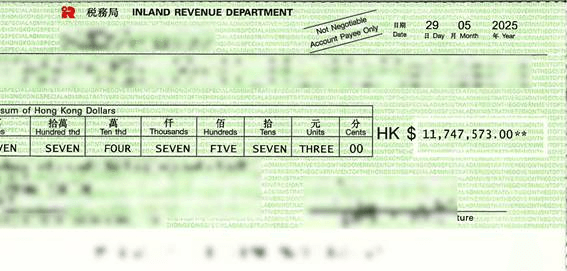
Figure 2 Refund cheque enclosed by the IRD with its notice (client, bank and signature details have been blurred).
Procedure | Key Time Requirement | Key Conditions |
|---|---|---|
Timely objection | Within one month after the date of the notice of assessment | State the grounds of objection clearly in writing. For estimated assessments, a completed tax return and supporting documents are generally also required. |
Late objection | Considered case by case by the Commissioner of Inland Revenue | Explain and substantiate how absence from Hong Kong, sickness or another reasonable cause prevented a timely objection. |
Section 70A correction | Within six years after the end of the relevant year of assessment, or six months after service of the notice of assessment, whichever is later | Requires an error or omission in a return or statement that resulted in excessive tax; it does not simply extend the objection deadline. |
Tax payment and holdover | By the date stated in the notice of assessment | An objection does not automatically suspend payment. Unless a holdover is granted, tax remains payable on time. Any tax already paid may be refunded following a revised assessment. |
Options After the One-Month Objection Period
Under section 64 of the IRO, a taxpayer who disagrees with an assessment must, in principle, lodge a written objection within one month after the date of the notice of assessment, stating the grounds precisely. The key is not merely whether an objection was made in writing, but also whether it was received within the deadline, whether the grounds were sufficiently specific, and whether the relevant tax return information had been submitted.
Expiry of the one-month period does not necessarily end the matter. A taxpayer may consider other statutory remedies under the IRO. A late objection must meet its own statutory requirements. Where a submitted return or statement contains an error or omission, the taxpayer should separately assess whether section 70A applies. These routes have different legal bases, deadlines and evidential requirements.
Why We Used Section 70A in This Case
For a late objection, the central question is whether the taxpayer was prevented from objecting within one month by absence from Hong Kong, sickness or another reasonable cause. Merely believing the tax was too high, or subsequently recognising a possible offshore claim, does not automatically justify an extension.
Section 70A addresses excessive tax arising from errors or omissions in a submitted return or statement. A written correction application must be made within six years after the end of the relevant year of assessment, or within six months after service of the notice of assessment, whichever is later, and must identify the specific errors or omissions and provide supporting evidence.
We had to show how the original auditor's mistakes led to errors or omissions in the tax filing and, in turn, to excess tax. We also had to substantiate the offshore source of the profits through transaction evidence. Section 70A does not permit an assessment to be reopened simply because the objection deadline was missed; the taxpayer must establish an error or omission that qualifies for correction.
Why Tax Already Paid Could Still Be Refunded
Paying tax and determining whether an assessment is correct are separate matters. Even if a taxpayer has lodged an objection, the tax must still be paid by the date specified in the notice of assessment unless the Commissioner of Inland Revenue grants a holdover. Businesses often pay first to avoid late-payment surcharges and recovery action; doing so does not automatically waive all statutory rights.
That is precisely what happened here. The client paid the original assessment in full, then received a revised assessment and a refund of the overpayment after the section 70A application was accepted. Whether the IRD can correct an assessment does not depend on whether the tax has already been paid. It depends on whether the application is made within the section 70A deadline, whether errors or omissions exist in the original return, and whether the evidence shows that the assessment was excessive.
The Two Types of Evidence Needed
Our application had to establish both why the original filing was wrong and why the profits included in Hong Kong assessable profits qualified for an offshore claim. We linked each point to specific amounts and supporting documents to provide a complete basis for correction.
- Prove that the original return was wrong We compared the original auditor's report, tax computation, Profits Tax Return and assessment to show how the profits had originally been treated, what information was omitted, and how this overstated assessable profits and tax. The client's reliance on the original auditor's treatment also formed part of our explanation of how the errors arose.
- Prove that the profits arose offshore We examined the operations that produced the profits and where those operations took place, using verifiable business records. Incorporation in Hong Kong, the location of the receiving bank account and the movement of goods cannot, individually, determine the source of profits.
- Reconcile the evidence to the amounts For each transaction, we matched contracts, communications, order processing, delivery and settlement records against the accounts and proposed profit adjustments. We explained which profits should be excluded from Hong Kong assessable profits and how the corresponding tax was calculated. The exact documentation depended on the records actually retained by the client.
- Submit a complete correction application Our written application identified the errors or omissions in the original return, why the client had not previously made an offshore claim, the revised tax computation, and the evidence supporting the source of profits. The IRD ultimately accepted the correction, revised the assessment and refunded the tax.
Contemporaneous business records formed the basis of this work. Section 51C of the IRO requires persons carrying on business in Hong Kong to maintain sufficient business records, generally for at least seven years. Where a filing error is discovered years later, records capable of reconstructing the original transactions are often more persuasive than an explanation prepared after the event.
What to Do After Receiving a Notice of Assessment
- Identify the dates Retain the complete notice of assessment, envelope, electronic notifications and forwarding records. Confirm the notice date, details of service, objection deadline and tax payment due date.
- Review the basis of the return Compare the auditor's report, tax computation, Profits Tax Return and assessment. Determine how the disputed amount arose and whether material facts concerning the source of profits were omitted.
- Choose the correct route If the one-month period has not expired, protect the right to object promptly. If it has expired, do not give up automatically: assess both the statutory grounds for a late objection and the possibility of correcting errors or omissions under section 70A.
- Manage payment risk Do not assume that filing an objection automatically suspends the obligation to pay. Apply promptly for a holdover if needed, and prepare any security the IRD may require.
- Link amounts to supporting evidence For an offshore profits claim, identify the key profit-producing activities for each transaction, their locations, the original supporting documents, the proposed adjustments to profits and the corresponding tax amounts. Explain how the documents support each part of the claim.
Distinguish the Time Limit for Additional Assessments from the Correction Period
Section 60 of the IRO principally governs the time limits for the IRD to raise additional assessments. Section 70A concerns correction of excessive assessments arising from errors or omissions in a return or statement. Although both provisions may refer to six years, they confer different powers and have different conditions and rules for calculating time. They do not create a general right to reopen any assessment within six years.
Conclusion
The client approached us two years after the one-month objection period had expired, having paid the tax in full and obtained no successful outcome from an earlier accounting team. We established errors in the original tax filing and substantiated the offshore source of the relevant profits. Our section 70A application then resulted in revised assessments and a refund. That outcome depended on qualifying errors or omissions, an application within the statutory deadline and sufficient supporting evidence; it does not mean that every assessment can be reopened after the objection deadline.
Businesses should review notices of assessment promptly and, wherever possible, object within one month. If the deadline has passed, the fact that tax has already been paid should not deter a review. In particular, businesses that did not originally make an offshore claim but later identify possible filing errors should check the section 70A deadline, original return documents and evidence on the source of profits without delay. A fresh review may still be worthwhile even if another team previously tried unsuccessfully to resolve the matter. We can assist in reviewing filing errors or omissions, transaction evidence and correction applications.
Key Legislation and Official Guidance
- Inland Revenue Department: Guidance on Objections to Assessments and Late Objections
- Inland Revenue Department: Corrections of Errors or Omissions in Submitted Profits Tax Returns
- Inland Revenue Department: Payment of Tax in Dispute and Interest on Tax Held Over
- Inland Revenue Department: Keeping Business Records
- Inland Revenue Department: A Brief Guide to the Territorial Source Principle of Taxation https://www.ird.gov.hk/chs/paf/bus_pft_tsp.htm