Hong Kong R&D Centre Reports HK$26.69 Million in Profit and Pays No Profits Tax How We Helped the IRD Understand the R&D Behind a Disinfection Device
ONC Lawyers | Nov 2026
Last year, we responded to an enquiry from the Inland Revenue Department (IRD) on behalf of a Hong Kong R&D centre and submitted information on its R&D activities and expenditure.
We recently received confirmation from the IRD that, for the year of assessment concerned, the company was not required to pay profits tax.
This confirmation followed our detailed review of the client's R&D activities and expenditure and our responses to the IRD's enquiries. The main challenge was explaining and substantiating the R&D. Our client was a scientist unfamiliar with tax matters, while the tax return alone did not give the IRD a clear picture of the R&D involved. We helped bridge that gap through clear explanations supported by evidence.
The company recorded accounting profits of approximately HK$26.69 million, yet its final profits tax payable was zero. This resulted from enhanced deductions for qualifying R&D expenditure, not a blanket exemption for corporate profits.
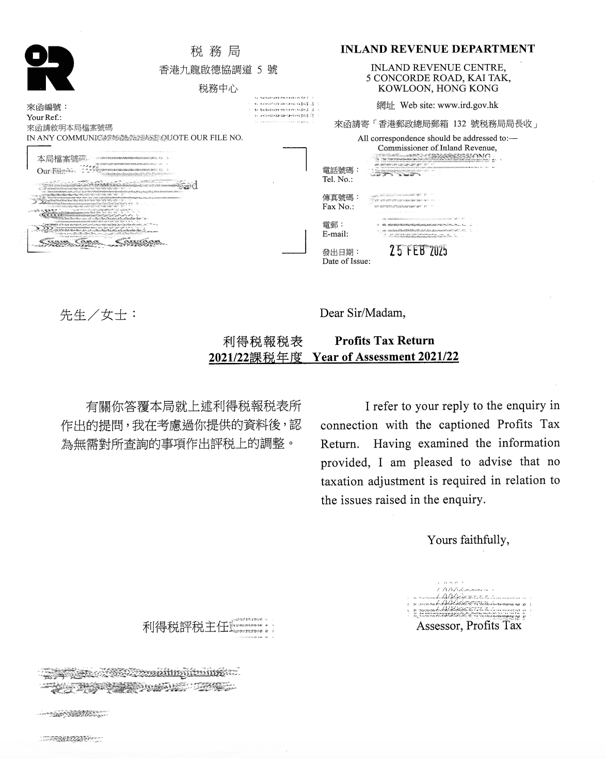
Figure 1 The IRD's reply to an enquiry concerning the 2021/22 Profits Tax Return: after reviewing our submission, the IRD considered that no adjustment to the assessment was necessary (client and IRD details have been blurred).
Below, we reconstruct the tax computation in this case and explain the respective scope of the enhanced R&D deduction and the Patent Box concession. This article is adapted from a case we handled. Client details have been anonymised, the tax figures are drawn from actual returns, and amounts have been rounded. The illustration is the IRD's closing letter on its R&D deduction enquiry for 2021/22; the calculations below use data for 2022/23. Enhanced R&D deductions were claimed on the same basis in both years.
What Made This Case Difficult
Although the outcome may appear to follow a simple formula, it depended on clear communication and supporting evidence:
1. Scientists are not tax specialists: The client's scientists understood the technology and product but were unfamiliar with Hong Kong profits tax, the conditions for deducting R&D expenditure and the IRD's enquiry process. They needed help addressing the specific tax issues raised by the IRD.
2. Financial statements do not explain the R&D: Assessors review accounts and tax returns. A disinfection device commonly seen during the pandemic may look like an ordinary product, but its underlying R&D investment and technical complexity are not apparent from financial statements alone.
3. Technical explanations must address tax requirements: The scientists described the technology, while the IRD asked about the statutory conditions. Without a clear connection between the two, both the eligibility of the R&D activities and the enhanced deduction for the related expenditure could be challenged.
4. We translated the technical work into supporting tax evidence: We reviewed the R&D projects, technical challenges, staff time records and allocation of expenditure, presenting the technical information in a form the IRD could understand and verify. Ultimately, the IRD confirmed that no profits tax was payable for the year of assessment concerned.
The decisive factor was explaining the company's R&D activities clearly and substantiating them with evidence.
I. Client Background
Our client is a business whose R&D is led by scientists. Its core product is disinfection equipment used in public places during the pandemic. Although the equipment may resemble ordinary products on the market, explaining the R&D behind it requires specialist input. In 2021, the company established its core R&D centre in Hong Kong for three main reasons:
- Hong Kong Science Park and Cyberport offer R&D businesses established incubation resources and funding support;
- The concentration of international talent makes it easier to recruit engineers from overseas;
- Hong Kong has a straightforward tax system and substantive R&D incentives—the focus of this article.
For the 2022/23 year of assessment, the Hong Kong company's accounts showed:
Item | Amount (HK$) |
Turnover | 187.53 million |
Qualifying R&D expenditure | 14.66 million |
Other costs and expenses | 146.18 million |
Accounting profit | 26.69 million |
Before allowing for the enhanced R&D deduction and other tax adjustments, a rough calculation applying the two-tiered profits tax rates to accounting profits of HK$26.69 million gives approximately HK$4.24 million. This is an illustration rather than a full tax computation. The following explains how the company arrived at a tax loss after the relevant deductions and adjustments.
II. Two Tax Incentives for R&D in Hong Kong
(1) Enhanced Tax Deduction for R&D Expenditure
From the 2018/19 year of assessment, qualifying R&D expenditure is eligible for enhanced deductions: 300% on the first HK$2 million and 200% on the balance. The relevant R&D activities must satisfy statutory requirements, including the requirement that they be carried out in Hong Kong. Outsourced R&D payments must be made to designated local research institutions; for in-house R&D, directly related employee and consumables costs must be assessed for eligibility.
(2) Patent Box Regime
The Patent Box regime took effect in July 2024 and applies from the 2023/24 year of assessment onwards. The concessionary portion of assessable profits attributable to eligible income from eligible intellectual property (patents, software copyrights and plant variety rights) may be taxed at 5%. That concessionary portion must be calculated using the R&D fraction. Costs of R&D outsourced to overseas related parties and the acquisition of intellectual property are generally excluded from qualifying R&D expenditure for that calculation.
III. R&D Deduction Computation and the Patent Box Time Frame
Enhanced R&D Deduction
The company incurred approximately HK$14.66 million in qualifying R&D expenditure during the year, all relating to staff and consumables for in-house R&D conducted in Hong Kong:
1. First HK$2 million × 300% = HK$6 million;
2. Remaining HK$12.66 million × 200% = HK$25.32 million;
3. Total deduction = HK$31.32 million.
The total enhanced R&D deduction was HK$31.32 million, compared with accounting profits of HK$26.69 million. Accounting expenditure and tax deductions must be reconciled in the tax computation; simply subtracting the total R&D deduction from accounting profit would not give the correct result. After the relevant add-backs, deductions and other tax adjustments, the company recorded a tax loss of approximately HK$11.23 million for the year.
Profits tax payable: HK$0. The tax loss may also be carried forward for set-off in subsequent years. The nil tax liability resulted from enhanced R&D deductions; R&D companies are not automatically exempt from profits tax.
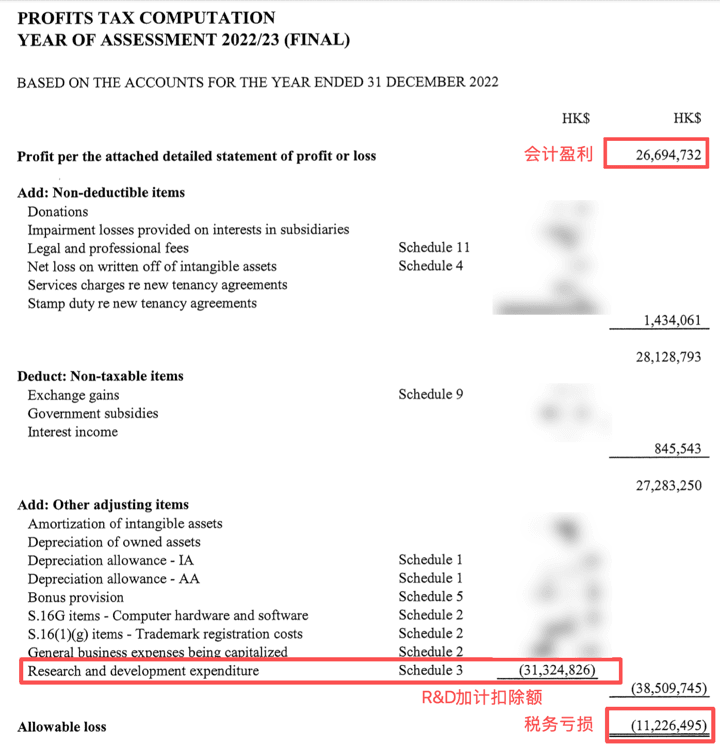
Figure 2 Extract from the client's 2022/23 profits tax computation: accounting profit of HK$26,694,732 and, after an enhanced R&D deduction of HK$31,324,826 and other items, a tax loss of HK$11,226,495 (adjustments unrelated to R&D have been blurred).
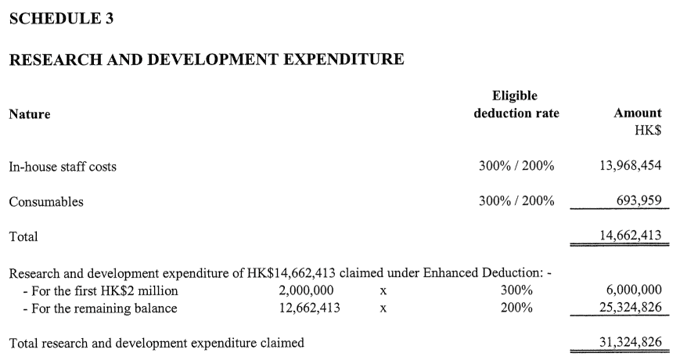
Figure 3 Schedule 3 to the tax computation: total qualifying R&D expenditure of HK$14,662,413, deductible at 300% on the first HK$2 million and 200% on the balance, giving a total deduction of HK$31,324,826.
Patent Box Applicability and Timing
The Patent Box regime applies from the 2023/24 year of assessment and was therefore unavailable for the 2022/23 computation illustrated here. For years within its scope, the 5% rate applies only to the concessionary portion of assessable profits derived from eligible intellectual property income. Product sales revenue may include an amount reasonably attributable to intellectual property value; a low proportion of royalty income alone does not rule out the concession.
The nil tax liability illustrated here resulted from enhanced R&D deductions and the other tax adjustments, independently of the Patent Box. For years in which both regimes are available, a business with qualifying R&D expenditure and eligible intellectual property income may benefit from both, subject to their respective conditions.
The two regimes address R&D expenditure and intellectual property income separately. The relevant expenditure, income and entitlement to intellectual property income must each be verified when preparing the tax return.
IV. When Is the Patent Box Useful?
Where a company has eligible intellectual property income, including royalties and a portion of the price of products or services reasonably attributable to intellectual property value, and still has related assessable profits after deducting R&D expenditure, it may consider the Patent Box. The concessionary portion subject to the 5% rate must also be calculated using the R&D fraction for each item of intellectual property.
Enhanced R&D deductions and the Patent Box may therefore be used together, but the 5% rate cannot simply be applied to all intellectual property income. Qualifying R&D expenditure, eligible intellectual property income and the corresponding assessable profits must be calculated separately.
V. Key Compliance Considerations
- Claims for enhanced R&D deductions must meet the requirements for qualifying R&D carried out in Hong Kong. If the substantive R&D remains in Mainland China, merely recording the expenditure in Hong Kong does not make it eligible for Hong Kong's enhanced deduction.
- Cross-border cost-sharing arrangements require case-by-case review. Whether overseas R&D expenditure is deductible, and in what amount, depends on the nature of the expenditure, where the R&D takes place and the source of business income, among other facts. Such expenditure cannot automatically be claimed as qualifying Hong Kong R&D expenditure at the enhanced rates. Intra-group cost allocations and reimbursement arrangements should be planned in advance.
- Keep records that substantiate the claim. Maintain R&D project documentation, staff time records, consumables allocations and records supporting the attribution of income to intellectual property. These records are essential to demonstrating eligibility for the incentives.
VI. Conclusion
Hong Kong's enhanced R&D deduction and Patent Box concession can complement each other. Their effect depends on the R&D activities, nature of the expenditure, eligible intellectual property income and assessable profits after deductions. Each business needs its own assessment. This case also shows that obtaining R&D tax relief often depends on explaining the R&D clearly to the IRD and supporting that explanation with evidence.
If your company is considering establishing an R&D centre in Hong Kong, already operates an R&D entity here but has not assessed the R&D deduction or Patent Box concession, or is responding to an IRD enquiry about its R&D activities, please contact us for a tailored tax computation and eligibility assessment.
(Edited: October 2026)
References
Inland Revenue Department: Patent Box Regime (English)
https://www.ird.gov.hk/eng/tax/bus_patentbox.htm
Inland Revenue Department: Patent Box Regime — Illustrative Examples (English) https://www.ird.gov.hk/eng/tax/patentbox_example.htm
Inland Revenue Department: Departmental Interpretation and Practice Notes No. 55 — Deduction for Research and Development Expenditure (English PDF)
https://www.ird.gov.hk/eng/pdf/dipn55.pdf
Inland Revenue Department: Press Release on R&D Tax Deduction Measures (November 2024, Chinese) https://www.ird.gov.hk/chi/ppr/archives/24112701.htm